
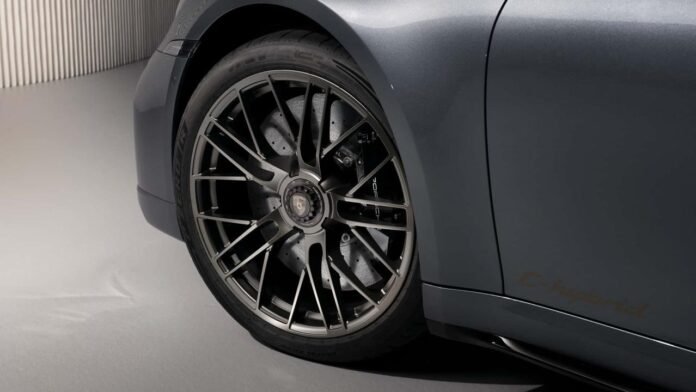

The new Porsche 911 Turbo S starts at $272,650 for the coupe and produces 701 horsepower — more than any 911 before it. Here is everything you need to know about how Porsche got there and what it means in practice.
A Brief History of Getting Here
The 911 Turbo has been around since 1975. For fifty years, Porsche has been squeezing more power out of essentially the same rear-engine sports car blueprint. Every generation pushed a little harder — more boost, better intercooling, smarter all-wheel drive. By the time the 992 generation arrived, the Turbo S was already producing 640 horsepower and doing 0-60 in 2.6 seconds. Numbers that seemed like a ceiling.
Porsche found a way through it.
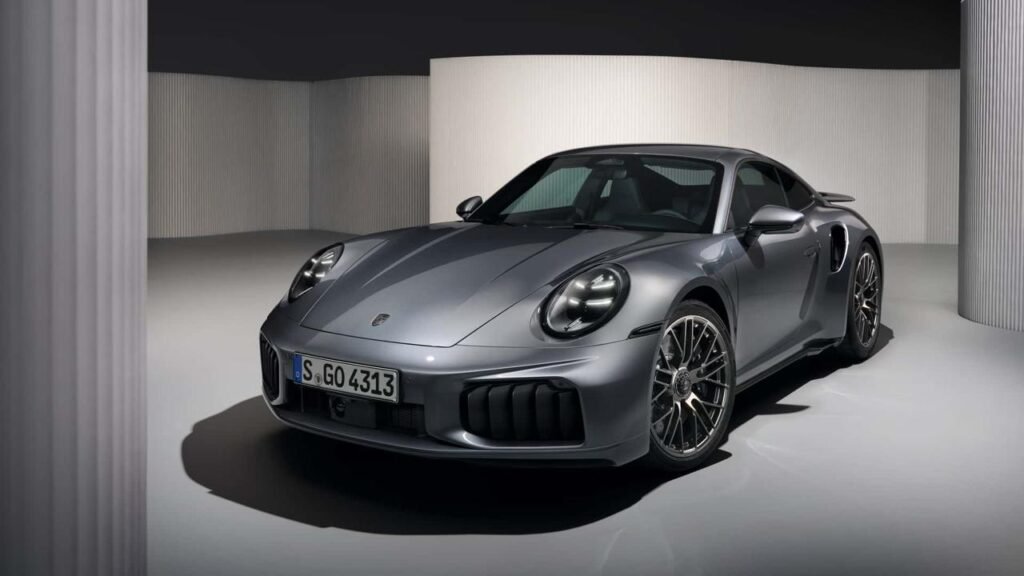
The 2025 911 Turbo S — part of the updated 992.2 generation — is not a new car from the ground up. It is the existing 911 architecture taken to a place nobody expected. The key change is what sits between the engine and the atmosphere: electrically assisted turbochargers. Two of them.
This is the first time Porsche has used electric turbine technology in a production 911, and the results are hard to argue with.
What Electric Turbines Actually Do
A traditional turbocharger spins up using exhaust gas energy. It works brilliantly at higher RPMs but has a well-known lag problem at lower speeds — the exhaust pressure has not built up enough to spool the turbine fast enough. Engineers spend enormous effort trying to minimize that lag through variable geometry vanes, twin-scroll housings, smaller turbine wheels, and other tricks.
Electric turbines take a different approach. Each turbocharger gets a small electric motor built directly onto the shaft. When you press the throttle and the engine has not yet generated enough exhaust flow to spool the turbo naturally, the electric motor steps in and spins the shaft immediately. There is no waiting. The boost arrives the moment you ask for it.
This does several things at once. It eliminates lag in a way that mechanical solutions cannot fully replicate. It also allows engineers to run larger turbine wheels — which flow more air at high RPM — without sacrificing low-end response. You get the benefits of a bigger turbo at the top end and a small turbo at the bottom end, simultaneously.
Porsche’s twin-turbocharged flat-six displaces 3.7 liters in this application. The engine itself has been reworked alongside the new turbocharger system, with revised cylinder heads, updated fuel injection, and a new exhaust system. The sum of all those changes is 701 horsepower and 627 lb-ft of torque.
For context, the previous 992.1 Turbo S made 640 horsepower. That extra 61 horsepower represents roughly a 10 percent gain, which is significant for any engine, but even more impressive in one that was already highly developed.
2.4 Seconds to 100 km/h
Porsche claims a 0-100 km/h (0-62 mph) time of 2.4 seconds. That is not a typo.
To put it in perspective: the previous 911 Turbo S did the same sprint in 2.6 seconds. The McLaren 720S does it in about 2.7 seconds. The Ferrari 488 Pista does it in 2.85 seconds. You would need to spend significantly more money on a hypercar to find something meaningfully quicker in a straight line.
Two-tenths of a second sounds small in isolation. On paper, it is barely a blink. In practice, on a highway on-ramp, the gap between 2.4 and 2.6 seconds is visceral. The acceleration at full throttle in the new Turbo S is the kind of thing that makes passengers instinctively reach for a handle.
The top speed is 330 km/h (205 mph). That figure has stayed consistent with the outgoing car, which tells you something about aerodynamics — the 911 Turbo S does not win the top speed race against some of its more exotic Italian competitors, but it was never trying to.
All-Wheel Drive and What It Takes to Handle 701 HP
Getting 701 horsepower to the road without turning sideways requires a serious chassis setup. Porsche’s Traction Management system — PTM — sends power to both axles and adjusts the front-to-rear split continuously based on grip, steering angle, throttle position, and speed.
Under hard acceleration, the system biases heavily toward the rear wheels. In slippery conditions or through a corner, it can send up to 40 percent of torque to the front axle. The transitions happen fast enough that you rarely notice them as discrete events — the car simply goes where you point it.
The rear-wheel steering system, which Porsche calls Rear Axle Steering, adds another layer of capability. At low speeds, the rear wheels turn slightly opposite to the fronts, effectively shortening the wheelbase and making the car feel more agile. At higher speeds, they turn in the same direction, which stabilizes the car during lane changes and at the limit.
The suspension is fully active on this specification. The system reads the road surface and adjusts damping rates at each corner in real time. Hit a pothole at 100 mph and the car has already started reacting before the wheel drops into it.
None of this is new technology in isolation. What Porsche has done is integrate these systems so completely that they feel invisible. The car does not feel like it is managing you. It feels like it is listening to you.
Carbon-Ceramic Brakes: Why They Matter at This Level
Standard steel brakes on a car with 701 horsepower would work. They would stop the car. But under sustained hard use — a track day, a mountain road with repeated downhill braking zones — steel rotors heat up, expand, and eventually fade. The pedal goes soft. The stopping distances grow.
Carbon-ceramic brake rotors handle heat differently. The material does not retain heat the same way steel does, and it does not expand as dramatically. This means the brakes perform more consistently across a wider temperature range. On a track, you can brake late and hard repeatedly without the pedal feel degrading.
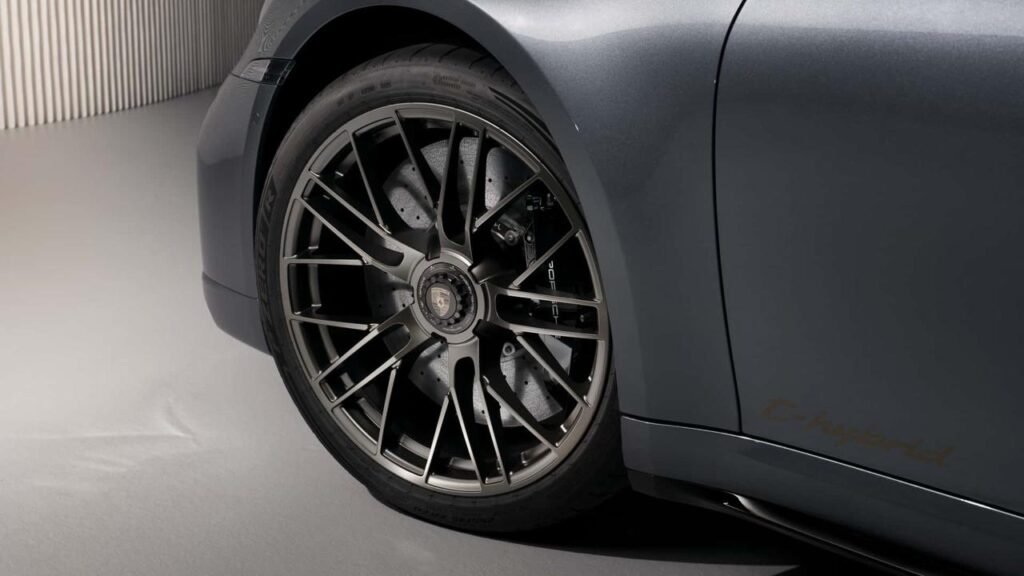
The 911 Turbo S comes standard with Porsche’s carbon-ceramic brakes — these are not an optional extra at this trim level. The front rotors are massive, and the calipers are fixed units with multiple pistons per side. The system is capable of decelerating the car from 100 km/h to a standstill in under 30 meters under optimal conditions.
There is a practical trade-off worth mentioning. Carbon-ceramic rotors do not love cold temperatures. If you drive the car gently on a cold morning, the brakes need a few miles of gradual use to reach an efficient operating temperature. This is normal behavior for the material, and experienced drivers account for it. It is also why Porsche includes a brake warm-up indicator in the instrument cluster.
The Tire Situation: 325 in the Rear, 315 in the Front
The 911 Turbo S runs 325-width tires at the rear and 315-width at the front. Those are very wide tires by any standard, and notably, the rear-to-front difference is smaller than you might expect from a rear-biased sports car.
The wide fronts serve a purpose. With all-wheel drive and rear-wheel steering, the front tires are doing real work — both in generating grip for braking and in providing steering feel. A narrow front tire would limit the car’s ability to change direction and would also create a visual imbalance that Porsche apparently wanted to avoid.
The tires are Michelin Pilot Sport Cup 2 R as standard — a semi-slick compound that is technically street-legal but optimized for track use. These tires offer exceptional dry grip but require careful use in wet conditions or cold temperatures. Porsche also offers the Pilot Sport 4S as an alternative for drivers who prioritize all-weather usability over outright lap times.
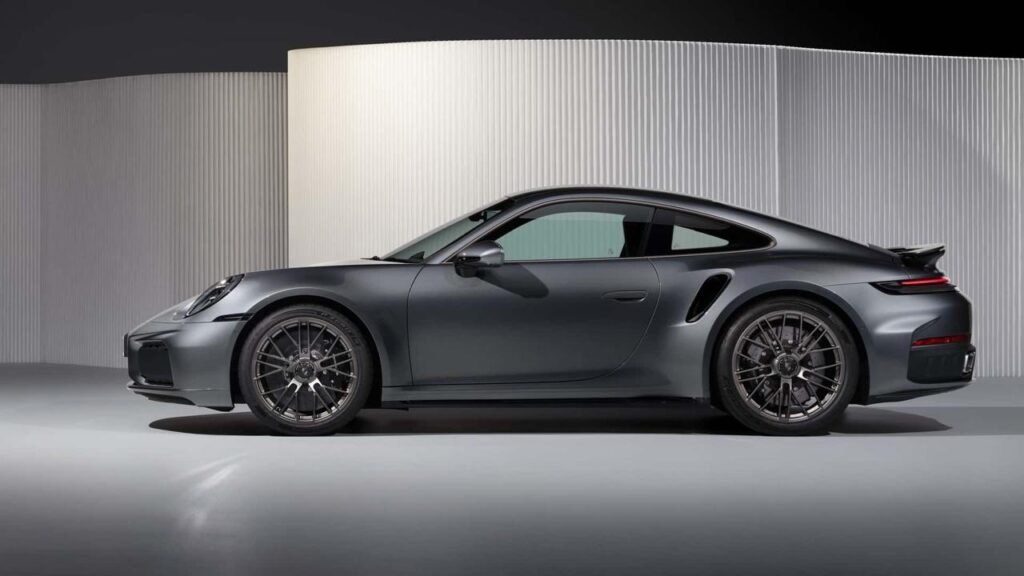
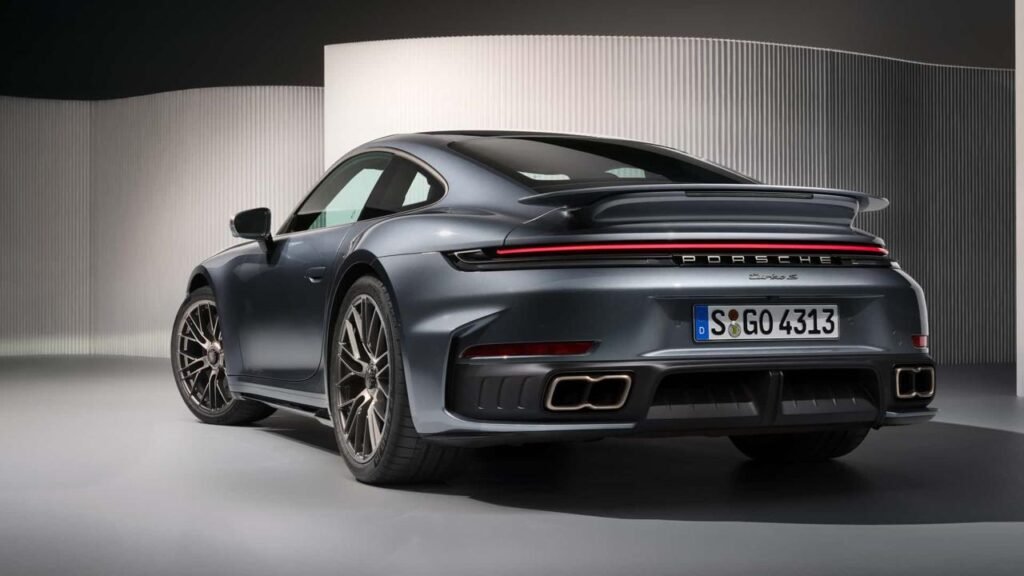
The wheel widths to accommodate these tires mean the rear haunches of the Turbo S are dramatically flared — the wide-body look has been part of the Turbo’s visual identity since the 1970s, and the 992.2 continues that tradition.
The Body and What It Costs
The coupe starts at $272,650 in the United States. A Cabriolet version is also available, typically adding around $15,000 to $20,000 over the coupe price.
That figure is the entry point, not a ceiling. The Porsche configurator is famous for how quickly options inflate the final price. Carbon fiber trim packages, rear-seat delete, exclusive paint colors, Burmester audio, and Porsche’s various performance packages can push a fully loaded Turbo S comfortably past $350,000 before you have finished clicking.
The coupe body is the version most buyers interested in performance will gravitate toward. It is stiffer than the Cabriolet by default, which benefits handling precision. The roof adds structural rigidity, which allows Porsche to tune the suspension with more confidence. If you plan to use the car on a track, the coupe is the more focused choice.
Aerodynamically, the Turbo S generates meaningful downforce at speed. The rear wing extends automatically based on vehicle speed and adjusts its angle depending on whether the car is in a comfort or sport mode. At 330 km/h, the wing is helping to press the rear tires into the road — which is one reason the car can actually use that speed safely.
Living With a 701-Horsepower Daily Driver
People do use 911 Turbo S cars as daily drivers. This sounds absurd until you spend time in one.
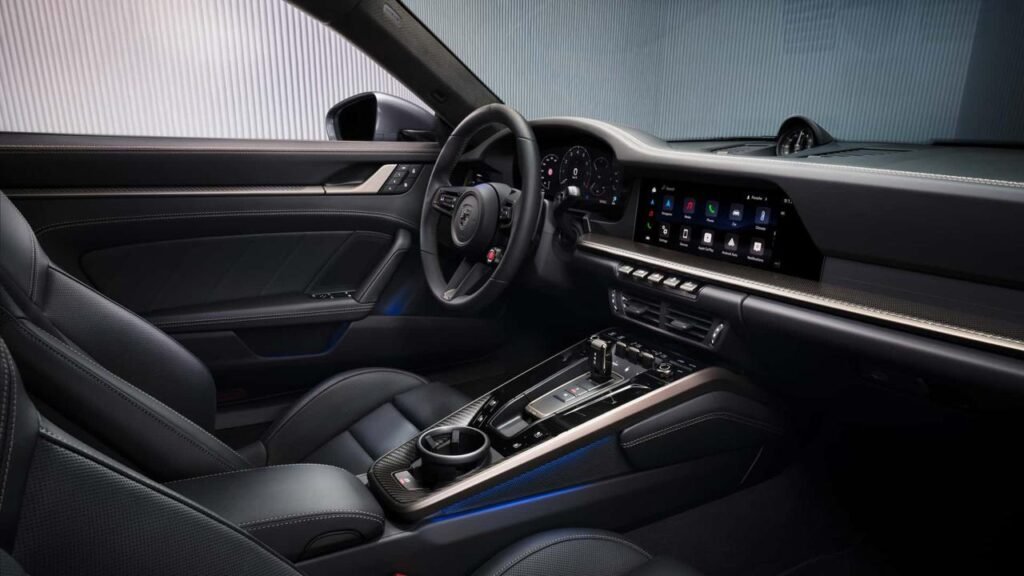
The ride quality in comfort mode is genuinely good. The active suspension absorbs road imperfections well enough that the car is not tiring to drive in city traffic. The cabin is quiet at highway speeds. The seats are supportive without being punishing. The infotainment system uses Porsche Communication Management, which runs on a 10.9-inch touchscreen and integrates Apple CarPlay and Android Auto.
The flat-six in the rear is not loud at cruising RPM. You hear it more as a subdued mechanical presence than a dominant sound. At full throttle, the exhaust note opens up — but this is not a car designed around acoustic drama. Porsche has left that to the GT3 RS crowd.
Fuel economy is what you would expect from a 3.7-liter twin-turbo six pushing this much power. Expect somewhere around 15-18 mpg in real-world mixed driving. The tank holds roughly 17 gallons, which means you will stop for fuel reasonably often on long trips.
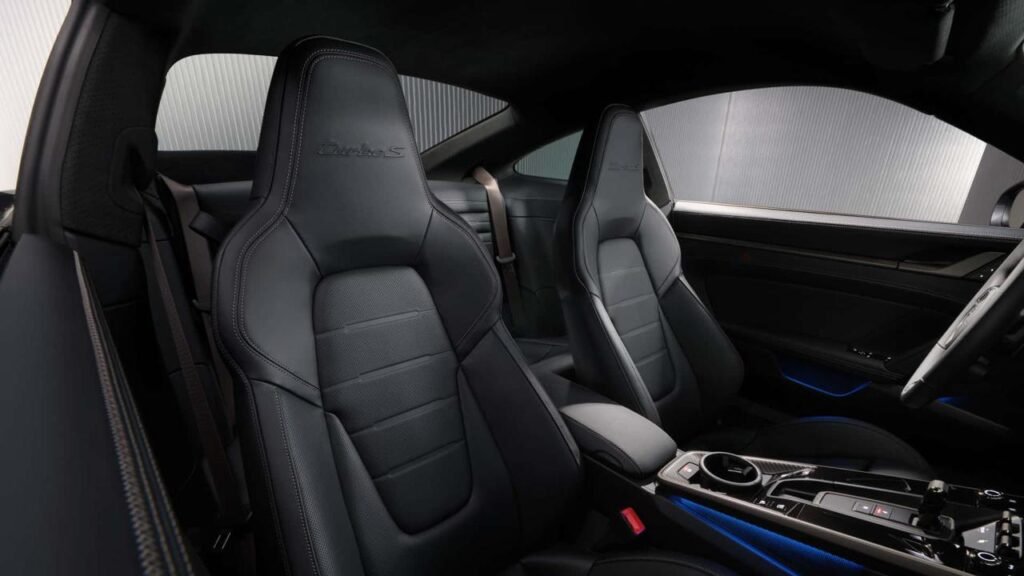
The back seats exist. They are usable for short trips by adults, or more comfortably for children. The front trunk (frunk) offers a small amount of storage — enough for a weekend bag. The rear area behind the seats adds more. By sports car standards, the 911 Turbo S is actually practical.
Who Buys This Car and Why
The 911 Turbo S sits at a specific intersection that few cars occupy. It is fast enough to embarrass dedicated supercars on a wet track day. It is comfortable enough to drive to work on a Tuesday. It holds its value better than almost any other car in its price range. And it has fifty years of 911 Turbo heritage behind it.
Buyers at this price point are often choosing between the Turbo S and something like a Ferrari Roma, a McLaren Artura, or a Lamborghini Huracan Evo. Each of those cars makes a compelling case in certain areas. The Ferrari is arguably more beautiful. The McLaren is lighter. The Lamborghini has a naturally aspirated V10 that sounds extraordinary.
What none of them match is the 911 Turbo S’s combination of all-weather usability, daily-driver comfort, long-term reliability, and track-ready performance in one package. Porsche has spent decades refining exactly that balance, and the 2025 car represents their best attempt at it so far.
The electric turbine technology is the headline, and it deserves the attention it gets. But it is really just the latest chapter in a fifty-year story of Porsche engineering a flat-six air-cooled (now water-cooled) rear-engine sports car to do things that should not be possible given its layout.
701 horsepower. 2.4 seconds to 100. $272,650 to start.
That is where the 911 Turbo S stands in 2025. It is the most capable production 911 in the car’s history, and if the past fifty years are any indication, it will not hold that title for long.

