

📊 Executive Summary: 2026 Catalytic Converter Scrap Values
In 2026, the average scrap payout for an authentic original equipment manufacturer (OEM) automotive catalytic converter ranges from $150 to $1,400+, dictated entirely by vehicle powertrain classification, engine displacement, and live commodity spot prices for platinum, palladium, and rhodium. High-efficiency hybrid vehicles—most notably the Gen 2 Toyota Prius (2004–2009)—lead the market with scrap valuations exceeding $1,100 to $1,450, while standard four-cylinder domestic cars fetch $120 to $280, and large diesel trucks command $450 to $950. Conversely, aftermarket replacement converters carry a negligible scrap payout of merely $15 to $45 due to microscopic precious metal washcoats.
If you are parting out a decommissioned automobile, replacing a clogged exhaust component in a repair shop, or assessing insurance claim settlements after an undercarriage mechanical mishap, understanding the real-time monetary worth of an automotive exhaust catalyst is paramount. Over the past decade, few automotive parts have experienced the extreme market volatility and commercial attention commanded by the exhaust catalytic converter. Beneath its unassuming, heat-tarnished stainless steel casing lies one of the highest concentrations of precious metals found in any consumer industrial product on Earth.
As ASE-certified Master Automotive Technicians and automotive core recycling analysts, we evaluate, dismantle, and test automotive emissions components daily. Entering 2026, global precious metal markets have stabilized following the chaotic volatility peaks of the early 2020s. However, structural shifts in automotive manufacturing, stringent Tier 3 and Euro 6d emissions compliance, and aggressive industrial recycling demand have cemented automotive catalysts as high-value liquid commodities.
Whether your vehicle has reached the end of its operational lifespan or you need an accurate, non-inflated valuation before negotiating with an authorized automotive core recycler, this authoritative catalytic converter scrap price guide 2026 delivers exact price tiers, make-and-model benchmarks, serial number lookup protocols, metallurgical explanations, and federal anti-theft legal guidelines.
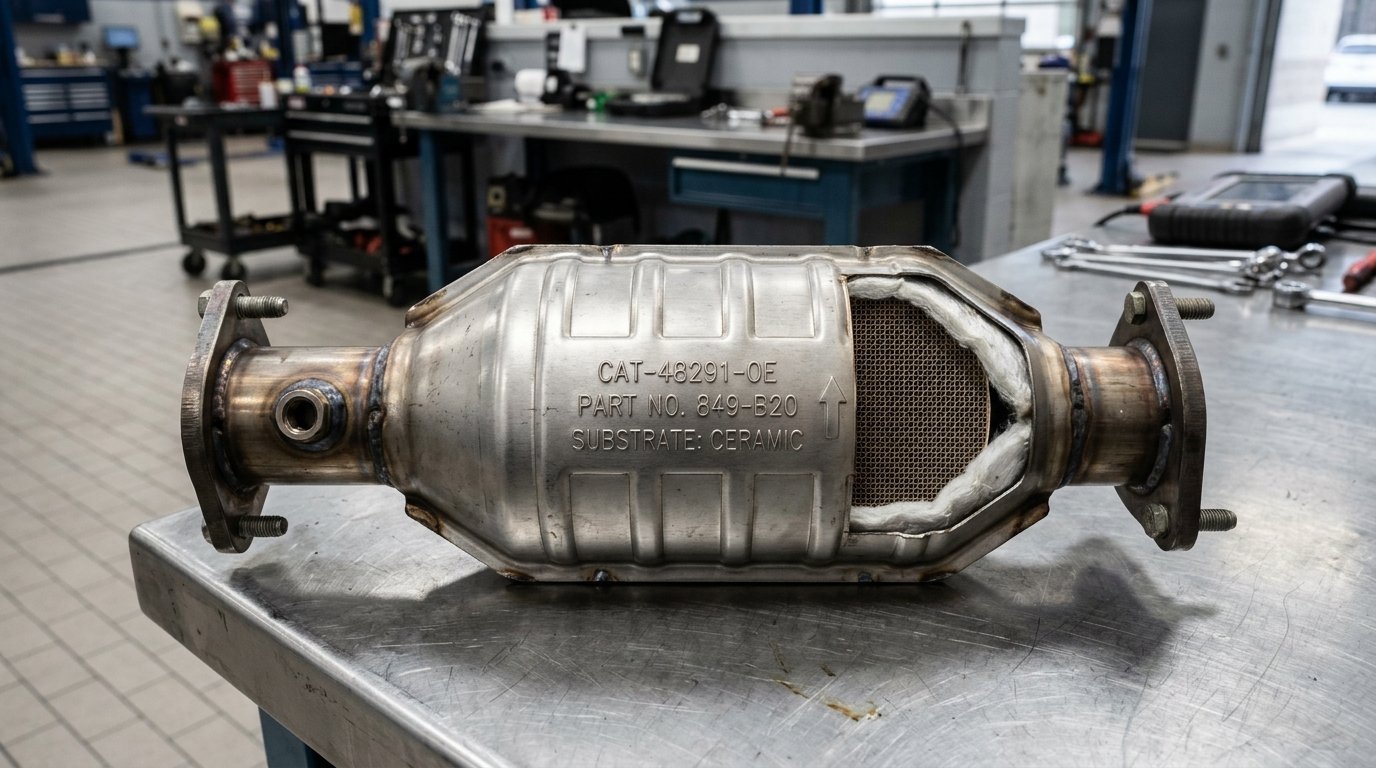
Figure 1: Authentic OEM automotive catalytic converter displaying a clearly legible casing serial number stamp and exposed precious-metal-coated ceramic honeycomb core.
1. Introduction & Market Overview: The Science of Precious Metal Loading (PGMs)
To understand why a rusty metal cylinder no larger than a loaf of bread can command more scrap value than the entire rest of a vehicle’s steel body, one must examine its microscopic internal architecture. An automotive catalytic converter is an internal combustion chemical reactor designed to convert harmful exhaust emissions—carbon monoxide (CO), unburned hydrocarbons (HC), and toxic oxides of nitrogen (NOx)—into harmless water vapor (H2O), carbon dioxide (CO2), and inert nitrogen gas (N2).
This exhaust purification cannot occur through steel filtration alone; it requires an active chemical catalyst. Inside the outer shell rests a dense ceramic honeycomb monolith made of cordierite, extruded with thousands of microscopic parallel flow channels. This substrate is coated with a porous aluminum oxide “washcoat” embedded with atomic nanoparticles of the three rarest and most valuable Platinum Group Metals (PGMs):
- Platinum (Pt): Serves as an aggressive oxidation catalyst, rapidly oxidizing toxic carbon monoxide and raw unburned fuel vapors into benign carbon dioxide and water. In 2026, platinum trades between $950 and $1,050 per troy ounce. It is especially prominent in heavy-duty commercial vehicles and diesel particulate filter (DPF) architectures.
- Palladium (Pd): A premier oxidation catalyst with exceptional thermal tolerance in high-heat gasoline combustion environments. While palladium experienced historic spikes above $2,800/oz in prior years, 2026 trading has settled into a steady range of $1,000 to $1,250 per troy ounce.
- Rhodium (Rh): The undisputed king of automotive metals. Rhodium is an extraordinary reduction catalyst responsible for stripping oxygen atoms from harmful nitrogen oxides (NOx), transforming them into breathable nitrogen. Because rhodium is an exceptionally scarce byproduct of platinum and nickel mining, it commands staggering commodity valuations—trading between $4,500 and $5,200 per troy ounce in 2026. Even a fraction of a single gram of rhodium within an exhaust core adds hundreds of dollars in scrap recycling value.
A standard OEM passenger vehicle converter contains between 3 to 7 grams of combined PGMs, while large trucks and specialized hybrids carry up to 12 to 15 grams. When raw commodity tickers fluctuate on international bullion exchanges like the London Platinum and Palladium Market (LPPM), automotive core recycling payouts shift in near-perfect lockstep.
2. How Much Is a Scrap Catalytic Converter Worth in 2026?
Vehicle owners frequently ask: “How much is a scrap catalytic converter worth?” The short answer is that no single universal price tag exists. In the automotive dismantling trade, buyers classify catalytic converters into distinct valuation tiers based on engine displacement, factory emission certifications (Federal EPA vs. California CARB), and cylinder bank configurations.
Below is the authoritative 2026 scrap price tier breakdown for intact, original factory (OEM) units:
Small / Compact Cars (Gasoline)
Common in 4-cylinder economy hatchbacks and compact sedans (e.g., Honda Civic, Chevy Cruze, Nissan Sentra, Ford Focus). Features modest precious metal loading designed for lightweight vehicle emissions.
Midsize Sedans & Crossovers
Standard in V6 and turbocharged 4-cylinder engines (e.g., Honda Accord, Toyota Camry, Subaru Outback, Ford Explorer). Often incorporates both a manifold converter (pre-cat) and an underfloor catalyst.
V8 Trucks, Large SUVs & Diesels
Heavy-duty gasoline V8s and turbo-diesel trucks (e.g., Ford F-250/F-350, Chevy Silverado 2500, Ram EcoDiesel). Packs substantial platinum washcoats to treat high exhaust volumes under heavy towing loads.
High-Grade Hybrid Vehicles
The undisputed crown jewel of automotive scrap (e.g., Toyota Prius Gen 2, Lexus CT200h). Engineered with extreme concentrations of palladium and rhodium to treat low-temperature cold-start emissions.
Aftermarket Replacements
Budget replacement units installed after a theft or mechanical failure (e.g., Walker, MagnaFlow Standard, Eastern). Contain bare-minimum washcoat metals designed strictly to clear inspection codes.
3. Comprehensive 2026 Scrap Price Table by Vehicle Make & Model
Automotive recyclers do not purchase converters based on vehicle curb weight or paint color; they rely on empirical scrap yield data. To help you evaluate your specific automobile, our technical team has cross-referenced national core buyer transaction sheets, automotive scrap auctions, and assay refiner spreadsheets to compile this detailed catalytic converter scrap value chart 2026.
*Note on Pricing Fluctuations: Values in the table above represent uncrushed, intact OEM converters with complete ceramic monolith cores sold to licensed core processors in 2026. Emptied canisters (“hollowed out” shells) have zero precious metal value and fetch only standard scrap steel weight pricing ($0.05 to $0.08 per pound).
4. Why Hybrid Catalytic Converters Are Worth the Most: The Engineering Truth
One of the most frequent questions received by our master technicians is: “Which cars have the most expensive catalytic converters to scrap, and why does a 20-year-old Toyota Prius beat a modern luxury Cadillac?”
The answer lies in thermodynamic engineering and stringent automotive emissions mandates. In a conventional gasoline automobile, the internal combustion engine runs continuously from the moment you turn the key until you shut it off. Exhaust gases flow steadily at blistering temperatures ranging from 450°C to 800°C (842°F to 1472°F). Under these elevated thermal conditions, the precious metal washcoat inside the catalyst achieves “light-off” (the temperature at which chemical conversion becomes 90%+ efficient) within 30 to 60 seconds and remains intensely hot.
Hybrid electric vehicles operate on a radically different thermodynamic cycle. A hybrid powertrain constantly shuts down its gasoline engine while coasting, stopping at traffic signals, or driving under low-speed electric traction. As a result, the engine block, exhaust piping, and catalytic converter undergo relentless thermal cooling cycles:
- Low Exhaust Heat Operating Windows: Because the internal combustion engine cycles on and off dozens of times during a single urban commute, exhaust gas entering the converter frequently drops well below the optimal 350°C light-off threshold.
- Aggressive SULEV & California PZEV Mandates: To certify vehicles like the Gen 2 Toyota Prius as Super Ultra Low Emission Vehicles (SULEV) and Partial Zero Emission Vehicles (PZEV) in California and CARB-compliant states, Toyota engineers faced a difficult physics dilemma: How do you achieve near-zero tailpipe emissions when the exhaust stream is perpetually lukewarm?
- Heavy Precious Metal Washcoat Solution: The only engineering solution available was chemical overkill. Toyota and emissions supplier Denso loaded the ceramic honeycomb substrate with two to three times higher concentrations of palladium and rhodium compared to conventional sedans of the same vintage.
This extraordinary PGM density makes the Generation 2 Prius converter (specifically stamped with OEM codes like GD EA6) an immense gold mine for metal refiners. While hybrid battery modules gradually lose electrochemical capacity over time—a maintenance reality detailed in our guide on electric car battery replacement cost (2026 price guide)—the noble metals inside a hybrid converter never degrade or evaporate. Unless physically broken, melted by severe engine misfires, or stolen, an original hybrid converter retains its full precious metal payload indefinitely.
5. How to Check Your Exact Price Using the Serial Number / Stamp
In the automotive recycling trade, guessing a converter’s value by vehicle model year alone is an amateur mistake that often results in sellers getting lowballed by hundreds of dollars. Automakers routinely utilize two, three, or four distinct exhaust converter suppliers (e.g., Faurecia, Tenneco, Boysen, Eberspächer, Calsonic Kansei, Denso) across the exact same vehicle generation, depending on production plant location and destination emissions packages (California 50-State CARB vs. 49-State Federal EPA).
To find the exact payout value, professional scrap recyclers use scrap catalytic converter prices by serial number lookup protocols. Follow this step-by-step master technician workflow to locate and decode your serial number:
1
Safe Inspection & Surface Preparation
Ensure the vehicle exhaust is completely cold before touching the exhaust piping. Raise the vehicle safely on certified jack stands or an automotive lift. Using a coarse wire hand brush or fine steel wool, gently scrub road grime, surface rust, and thermal oxidation from the stainless steel shell and adjacent heat shield seams. Never grind aggressively with a power abrasive, as this can destroy the stamped lettering.
2
Locating the Stamped Alphanumeric Code
Examine the converter body closely with an LED inspection light. Automotive manufacturers roll-stamp or laser-etch a 6 to 12 character code directly into the metal shell, usually adjacent to the inlet flange, near the oxygen sensor bung, or directly on the center seam. Common examples include:
- Toyota / Lexus: Stamped with a 5-digit core number or letter-number pairing (e.g.,
GD EA6,12040,EA16). - Ford: Standard Ford engineering part prefixes (e.g.,
F81A-5E211-BA,4C34-5E212). - General Motors (GM): 8-digit numeric sequences (e.g.,
12564179,25160548) or alpha prefixes likeAC DELCO. - Honda / Acura: 3-to-4 character codes stamped near the neck (e.g.,
PLM,PND,R18). - German Vehicles (BMW / VAG / Mercedes): 7-to-10 digit sequences etched with the brand roundel (e.g.,
7 542 833,1K0 131 701).
3
Photographing the Serial Number & Flanges
Take three crisp, well-lit digital photos: one close-up macro shot of the stamped serial number, one wide profile photograph showing the entire converter from pipe-to-pipe (proving whether the pipes were sawed off flush or unbolted at the factory flanges), and one end-on angle looking directly through the pipe into the ceramic honeycomb core to verify that the internal monolith is intact and not melted or missing.
4
Submitting for Transparent Valuation
Input the decoded alphanumeric string into verified industry database platforms (such as the Eco Cat App, PGM Market apps, or established national core buyers like RRCats / Rockaway Recycling). A reputable licensed core buyer will provide a firm, transparent appraisal backed by current precious metal assay benchmarks rather than an arbitrary ballpark estimate.
6. OEM vs. Aftermarket Converters: The Massive 90% Price Gap
One of the most disheartening experiences for an unsuspecting vehicle owner or DIY mechanic occurs when they transport a catalytic converter to a scrap processing yard expecting a $400 payout, only to be offered an unceremonious $20 bill. In 99% of these cases, the component in question is an aftermarket replacement converter rather than an original factory OEM unit.
Understanding the massive 80% to 90% valuation cliff between OEM and aftermarket converters requires examining how aftermarket manufacturers operate:
When an original factory converter fails due to age or is cut off by exhaust thieves, replacing it with an authentic OEM part from a franchised dealership often costs between $1,800 and $3,500 installed. To provide a budget-conscious consumer alternative, aftermarket manufacturers like Walker, MagnaFlow, AP Exhaust, and Eastern produce universal or direct-fit replacements that retail for just $250 to $600.
To achieve this dramatically lower price point, aftermarket companies cut out 85% to 90% of the precious metals. Their washcoat contains barely enough platinum and palladium to satisfy the EPA’s minimum 25,000-mile emissions durability standard and extinguish the dashboard Check Engine light (P0420/P0430 DTC codes).
When a vehicle fails mandatory annual state smog testing due to an exhaust catalyst malfunction, diagnostic testing and repair costs can escalate quickly. If you are preparing an older car for inspection, review our companion analysis on how much does a car inspection cost (2026 emissions and safety guide) to budget properly between OEM replacements and aftermarket temporary fixes.
How Core Recyclers Detect Metal Purity with Handheld XRF Guns
In 2026, legitimate automotive scrap recyclers no longer rely on guesswork or trust verbal claims. Commercial core purchasing facilities utilize handheld X-ray fluorescence (XRF) spectrometers (manufactured by brands like Olympus, Thermo Scientific Niton, and Bruker). An XRF analyzer shoots high-energy X-rays into the exposed ceramic core, exciting the atoms of the washcoat.
As the electrons drop back into their ground state, they emit secondary fluorescent X-rays with specific energy signatures unique to platinum, palladium, and rhodium. Within 15 seconds, the digital display outputs the exact metal concentration down to parts per million (PPM). If a seller attempts to pass off an aftermarket converter or a hollowed-out honeycomb core as an expensive OEM unit, the XRF analyzer detects the low PGM concentrations instantly.
7. Legal Requirements & Protecting Your Vehicle from Theft
The explosive scrap value of automotive exhaust catalysts sparked a nationwide epidemic of automotive theft over recent years. In response, federal authorities, state legislatures, and municipal police departments enacted sweeping statutory reforms to eliminate the underground black market for stolen converters.
Before you transport a catalytic converter to an automotive recycler in 2026, ensure you possess the mandatory legal documentation required by law:
- Proof of Vehicle Ownership: You must present an unencumbered vehicle title in your name, an active state vehicle registration matching your personal credentials, or an authorized bill of sale establishing legitimate ownership of the vehicle from which the converter was removed.
- Valid Government-Issued Photo ID: Licensed recyclers are legally mandated to photocopy your state driver’s license or passport and log your personal address into a statewide law enforcement scrap reporting database (e.g., LeadsOnline).
- Itemized Automotive Repair Invoices: If you are selling an old converter replaced by an automotive repair facility, you must present the certified repair shop work order showing the installation of the replacement unit and the mechanic’s release of the old core.
- Traceable Non-Cash Payment: Cash-on-the-spot transactions for loose catalytic converters are strictly outlawed in almost all 50 states. Payment must be disbursed via paper check mailed to your registered address or processed through a direct electronic bank transfer with a mandatory 48-to-72-hour statutory holding period.
Proven Methods to Protect Your Vehicle from Catalytic Converter Theft
Exhaust thieves can slice through an automotive exhaust pipe with a battery-powered reciprocating saw in under 90 seconds. If your vehicle is parked outdoors or falls into a high-risk theft category (such as a Toyota Prius, Honda Element, or elevated 4×4 pickup truck), deploying mechanical theft deterrents is crucial:
- Install an Aluminum or Stainless Steel Skid Plate: Custom-fitted underbody armor plates (such as Cat Security or MillerCAT shield plates) bolt directly to the vehicle chassis using tamper-resistant hardware. They create a solid barrier that blocks reciprocating saw blades from accessing the exhaust pipes.
- Stainless Steel Aircraft Cable Clamps (CatClamp): Heavy-gauge braided stainless steel aircraft cables wrap repeatedly through the vehicle frame and around the converter body. Because flexible braided cable bends and vibrates instead of cutting smoothly when hit by a reciprocating saw, thieves quickly abandon the attempt.
- High-Temperature VIN Chemical Etching: Paint the catalytic converter casing with high-temperature fluorescent orange or neon green automotive ceramic exhaust paint, and etch your vehicle’s full 17-character Vehicle Identification Number (VIN) into the casing. Legitimate scrap yards will immediately refuse an etched converter whose VIN does not match the seller’s registration.
- Calibrated Undercarriage Tilt Sensors: Modern automotive security systems offer add-on dual-axis tilt and vibration sensors. If a thief jacks up one side of your vehicle in a driveway or parking lot, the alarm triggers instantly before the saw blade ever touches metal.
Maintaining proper exhaust and engine operating temperatures is also vital for converter longevity. Chronic engine overheating caused by cooling system failure can blow raw coolant into the exhaust stream, contaminating the catalytic washcoat and causing catastrophic substrate melt-down. If your vehicle displays erratic temperature fluctuations, consult our technical teardown on car radiator replacement cost (2026 complete repair guide) to safeguard your powertrain.
Frequently Asked Questions (FAQ Section)
How much is a scrap catalytic converter worth in 2026?
In 2026, an authentic original factory OEM catalytic converter fetches between $150 and $1,400+ in scrap recycling value. Exact payouts depend on vehicle powertrain, engine displacement, and live commodity spot prices for platinum ($950–$1,050/oz), palladium ($1,000–$1,250/oz), and rhodium ($4,500–$5,200/oz). Compact domestic gasoline cars average $120 to $280, large V8 diesel trucks range from $450 to $900, while hybrid vehicles like the Toyota Prius reach $1,100 to $1,450. Aftermarket replacements are worth only $15 to $45.
Which car has the most expensive catalytic converter to scrap?
Among mainstream consumer production vehicles, the Generation 2 Toyota Prius (2004–2009) holds the highest scrap value, routinely yielding $1,100 to $1,450 for its original dual-catalyst assembly. Because hybrid engines frequently shut off and operate with cooler exhaust gases, Toyota loaded the Gen 2 Prius catalyst with extraordinary concentrations of noble palladium and rhodium to meet stringent SULEV/PZEV emissions. Exotic sports cars like Ferrari and Lamborghini feature multi-converter systems that can exceed $2,500 to $3,500 in total scrap recovery.
Can I sell a catalytic converter without the car title?
No. Under modern state and federal scrap metal anti-theft laws, licensed automotive core recyclers are strictly prohibited from purchasing loose catalytic converters without verifiable proof of vehicle ownership. You must provide a matching vehicle title, active state registration in your name, or an itemized mechanic repair work order proving legitimate ownership. Furthermore, transactions require government photo ID, law enforcement reporting, and traceable check or bank transfer payments.
How do I find the serial number on my catalytic converter?
Allow the exhaust to cool, safely raise the vehicle, and clean the stainless steel converter canister using a soft wire hand brush or steel wool. Look for a roll-stamped or laser-etched alphanumeric sequence containing 6 to 12 characters located near the inlet flange, center welded seam, or oxygen sensor port. Common examples include GD EA6 (Toyota Prius), F81A (Ford), or 12564179 (GM). Input this code into a certified core buyer database for an exact assay quote.
Why are aftermarket catalytic converters worth so little in scrap?
Aftermarket replacement converters (brands like Walker, Eastern, and MagnaFlow) fetch only $15 to $45 because they contain up to 90% less platinum, palladium, and rhodium than factory OEM units. Aftermarket manufacturers apply a microscopic washcoat engineered strictly to meet minimum EPA 25,000-mile emissions thresholds at a low retail price. When processed by scrap refiners, the extracted noble metal yield barely offsets industrial processing energy costs.
ByOne Auto Certified Technical & Scrap Market Advisory Team
Authored by ASE-Certified Master Automotive Technicians and automotive core recycling analysts. Our editorial staff tests exhaust systems, evaluates metallurgical assays using XRF spectrometry, and monitors global PGM commodity exchanges to deliver accurate, unbiased automotive maintenance and valuation guidance.

