
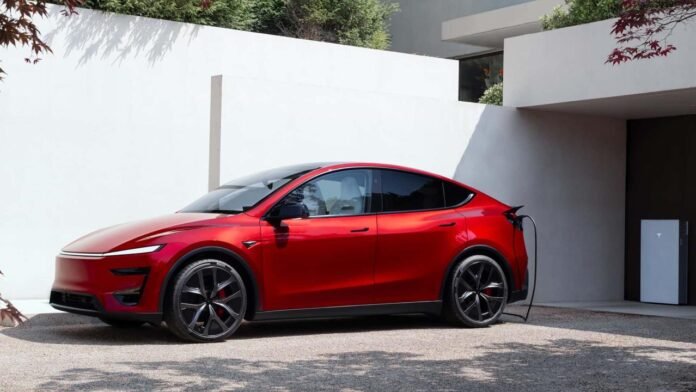

The Tesla Model Y is already one of the most recognizable cars on European roads. Walk through any major city parking lot and you’ll spot several. So when Tesla quietly updated the lineup and slipped in a Performance variant, the obvious question became: how do you actually tell one apart from a standard Model Y? And once you figure that out, should you care?
Let’s go through it properly.
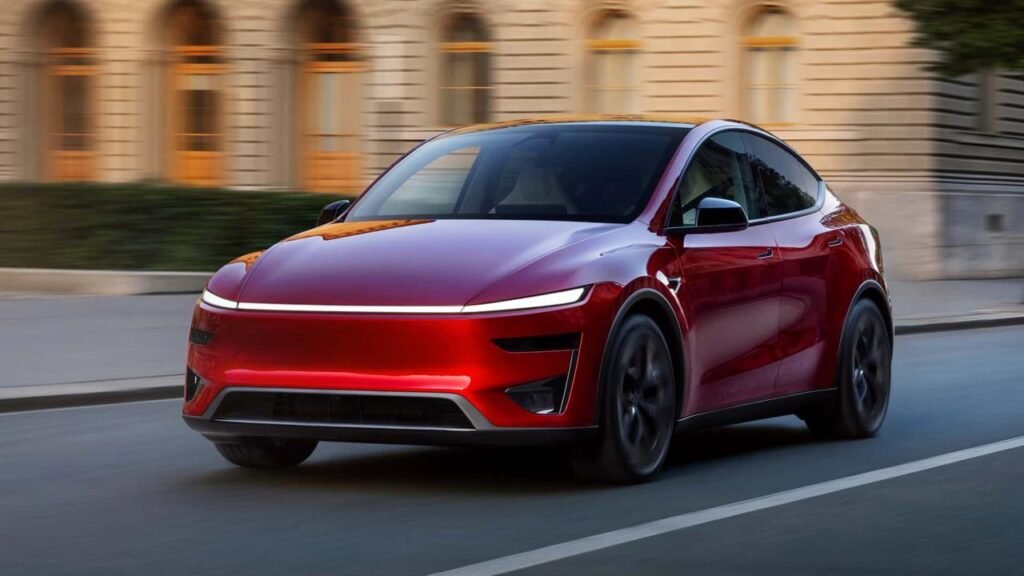
The Performance Model Y Is Already Here
Tesla has officially launched the new Model Y Performance in Europe, and it’s available to order right now. The starting price is €61,990, which puts it a meaningful step above the standard Long Range model.
That price gap buys you more than just a badge. Tesla has made real, physical changes to this version — changes you can see from 50 meters away if you know what to look for, and changes you’ll feel the moment you press the accelerator.
How to Spot a Model Y Performance From the Outside
This is where things get practical. If you’re standing in a parking lot or at a traffic light and you want to know whether that Model Y next to you is a Performance or not, here’s what to look at.
The Wheels
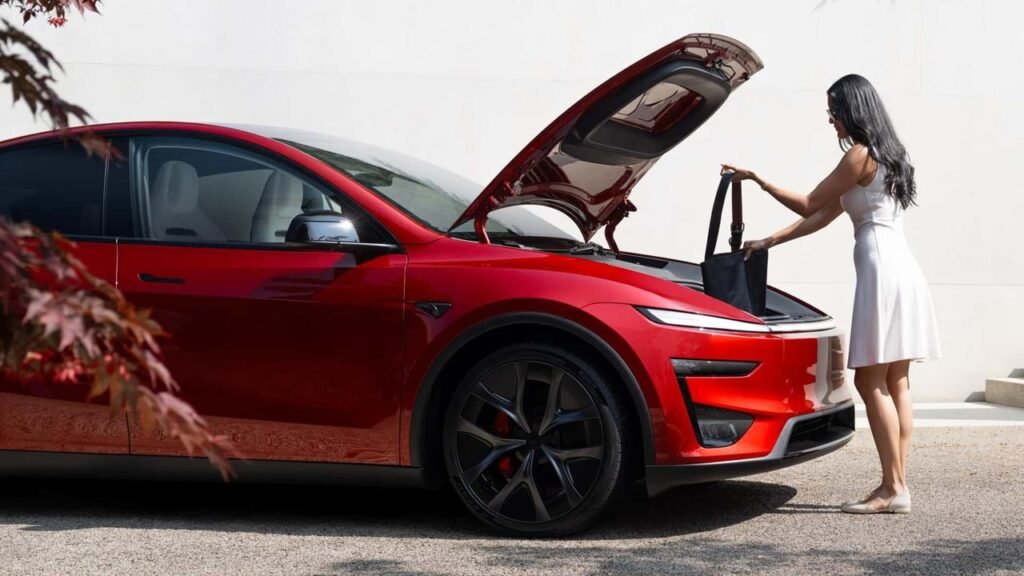
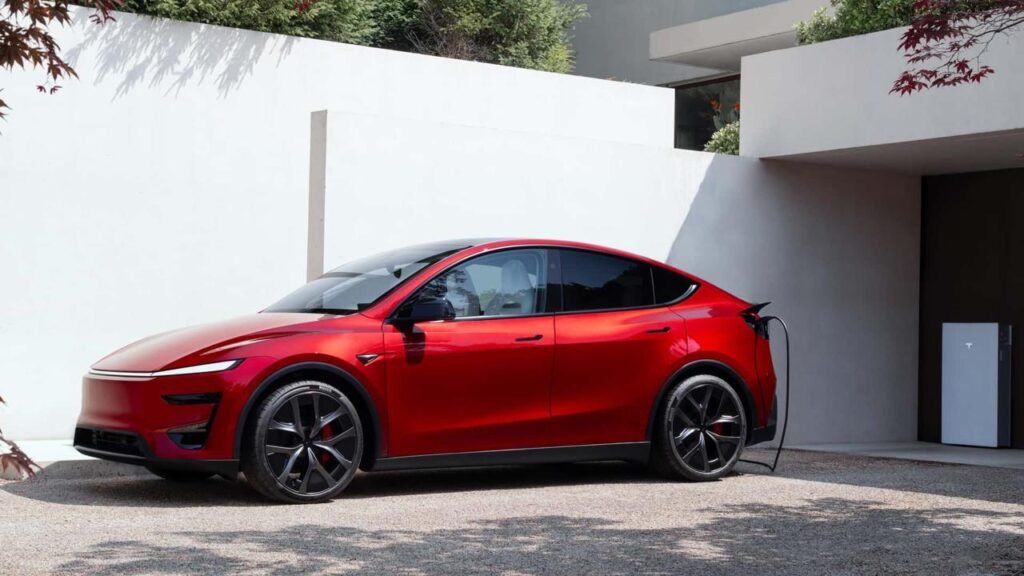
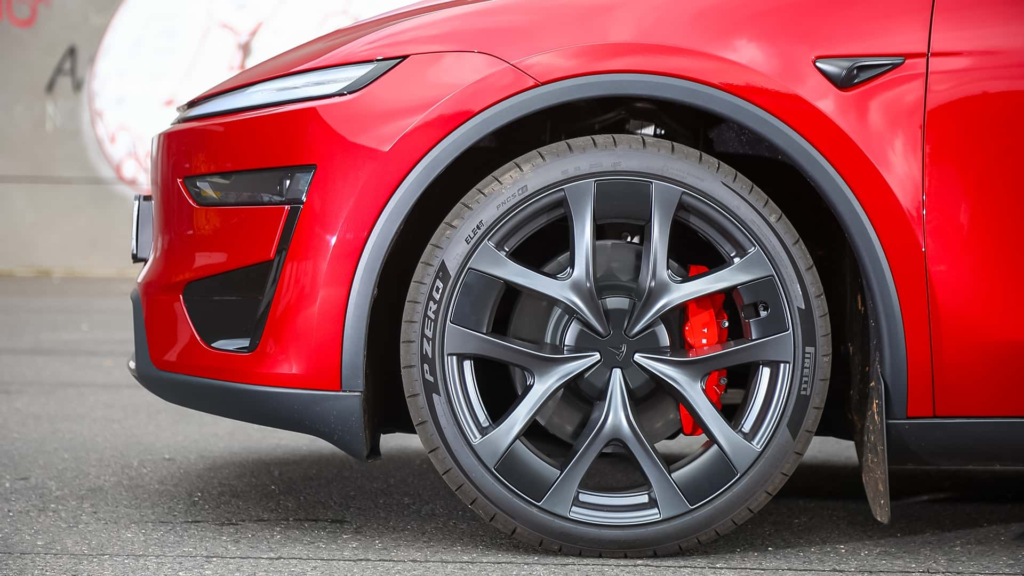
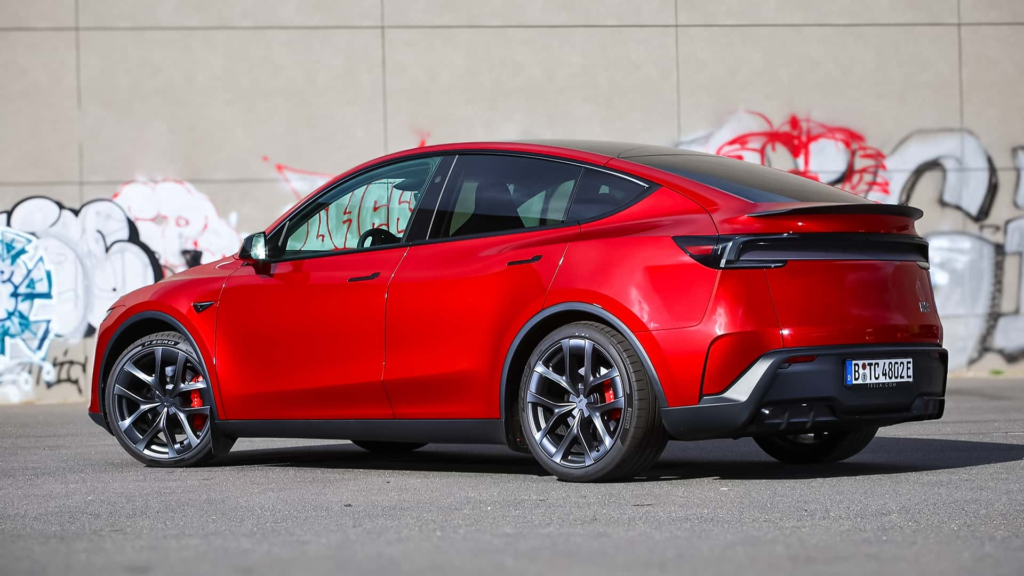
The clearest tell is the wheels. The Model Y Performance comes fitted with 21-inch wheels in a specific design that Tesla calls R21. These are larger than what you get on the standard Long Range variant, and the design itself is distinct enough that once you know it, you won’t confuse it.
Larger wheels on a performance-focused car are a well-established approach. They allow for wider, lower-profile tires that give the car sharper handling response. There’s a trade-off — the ride can feel firmer on rough roads — but if the driver wanted comfort above all else, they’d have bought a different model.
The Brake Calipers
Look through the spokes of those R21 wheels and you’ll see red brake calipers. This is a small but deliberate detail that communicates exactly what kind of car this is. On the standard Model Y, the calipers are a plain silver. Red calipers on a production car are almost always tied to performance-oriented hardware underneath, and that’s the case here.
The Carbon Fiber Spoiler
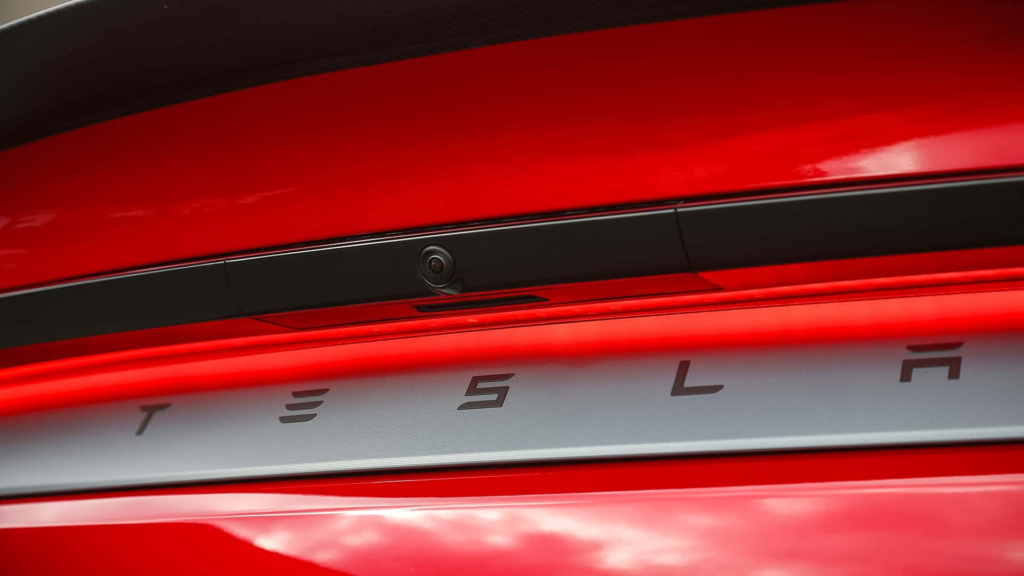
The Performance gets a large carbon fiber spoiler mounted at the rear. This isn’t a subtle lip — it’s a proper spoiler that affects how the car looks and, at speed, how it behaves aerodynamically. Carbon fiber has become the material of choice for spoilers on performance cars because it’s stiff and light, which is exactly what you want when you’re adding something to the rear of the vehicle.
This spoiler, combined with the R21 wheels and red calipers, makes the Performance variant visually distinctive even to someone who has never paid much attention to Teslas before.
What’s Different Inside
The exterior changes make the car identifiable from outside. The interior changes make the case for actually spending the extra money.
The Seats
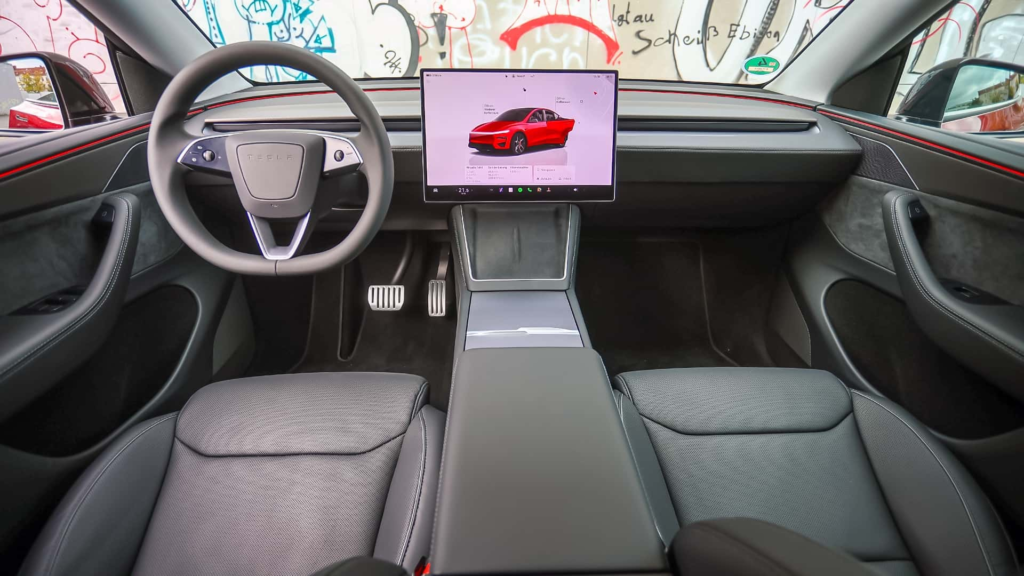
The Performance model comes with different seats. These aren’t merely reupholstered versions of the standard chairs — they’re a different design with built-in ventilation. Ventilated seats matter more than people give them credit for, particularly if you live somewhere warm or spend time in stop-and-go traffic in summer. The combination of better lateral support (useful when the car is capable of serious cornering forces) and ventilation makes these seats genuinely better for spirited driving and long trips alike.
The Screen
Tesla has fitted the Performance with a larger screen at a higher resolution compared to the standard Model Y. This is notable because the standard Model Y’s screen is already larger than most of what you’ll find in the segment. Going larger and sharper again means media, navigation, and all of Tesla’s software experience is displayed with more clarity and more space.
For people who use the car’s integrated entertainment features on long trips, or who just appreciate a sharp display for daily use, this is a real improvement.
Double Glazing
The Performance model includes double-glazed windows. This is one of those features that sounds boring until you’ve driven with it and then driven without it. Double glazing reduces road noise and tire noise considerably. Combined with the acoustic improvements that come from building an electric car to begin with, the Performance ends up being noticeably quieter inside than the standard variant.
For long motorway drives, this matters a lot. Wind noise and tire roar are the main sources of fatigue on high-speed runs, and reducing them makes a four-hour drive feel different from a standard cabin to a more refined one.
The Numbers: Power and Acceleration
Here’s where the Performance model earns its name in the most direct way.
Output is rated at 460 horsepower. That’s the combined figure from dual motors — one on each axle, meaning this is an all-wheel drive setup as standard.
The acceleration figure is 0 to 100 km/h in 3.3 seconds.
To put that in context: 3.3 seconds is fast in any category. It’s faster than most sports cars from a decade ago. It’s competitive with purpose-built performance vehicles that cost significantly more. In everyday use, that kind of acceleration means instant, confident overtaking on country roads, effortless motorway on-ramp merging, and a general sense that you’ll never be caught short.
The way electric motors deliver power matters here too. There’s no waiting for a turbocharged engine to build boost, no gear change in the middle of a hard acceleration run. The power comes immediately, linearly, and predictably. Drivers who switch from conventional performance cars often find this the most disorienting thing at first — not because it’s unpleasant, but because they’re conditioned to anticipate a surge that doesn’t arrive in the expected way.
What the Standard Model Y Gives You, by Comparison
It’s worth being clear about what you’re stepping up from, because the standard Model Y is a genuinely accomplished car.
The Long Range Model Y is comfortable, spacious, efficient, and reasonably quick. It covers family duties well, has a practical interior, and the software experience is the same Tesla ecosystem that has attracted buyers for years. Nothing is broken about it.
The Performance model is not fixing a problem with the standard car. It’s a different proposition for a different buyer.
Who Should Actually Buy the Performance Variant
If you drive mostly in urban areas, park in tight spots, and want maximum efficiency above everything else, the standard Long Range is probably the better call. Larger wheels mean slightly more road noise in normal conditions, a firmer ride on bad surfaces, and marginally less efficiency.
If you do regular long motorway runs, care about interior refinement, enjoy the dynamics of a quick car, or simply want the best version of the Model Y available — the Performance makes its case clearly. The combination of double glazing, ventilated seats, the better screen, and the real-world performance increase is a coherent package. It’s not a collection of random upgrades; everything points in the same direction.
The price difference between the Long Range and the Performance variant will vary by market and configuration, but at €61,990 as a base price in Europe, you’re buying a car that competes directly with performance versions of the BMW X3, Mercedes GLC, and Audi Q5 — vehicles that are quick in their own right but don’t get close to 3.3 seconds to 100 km/h.
Comparing the Performance Model Y to Its Rivals
Spending around €62,000 on a performance-focused SUV opens up a few options, so let’s be direct about how the Model Y Performance stacks up.
BMW M340i Touring (comparable price range): Fast, with a brilliant six-cylinder engine, and excellent driver feedback. Doesn’t match the Tesla for raw acceleration. Doesn’t have the same seamless software integration. Fuel costs are higher.
Audi SQ5: Refined, well-built, capable. Gets to 100 km/h in around 4.9 seconds, which is quick for a diesel-based SUV but not in the same conversation as 3.3 seconds. Interior quality is arguably better in terms of physical material choice, but the infotainment system is behind Tesla’s.
Porsche Macan Electric (base): A genuinely strong competitor. Excellent driving dynamics, premium build quality, similar price territory. It’s the most credible alternative if driving feel is your priority over straight-line speed.
The Model Y Performance wins clearly on acceleration and software experience. It’s competitive on practical space and feature content. Porsche is the brand to consider if the feel of the car matters as much as the numbers.
Charging, Range, and Practical Ownership
Performance models typically trade some efficiency for speed capability, and that applies here. Expect a real-world range figure somewhat below what the Long Range manages, particularly if you’re using the full performance capabilities regularly.
For most European drivers, the Supercharger network makes longer trips straightforward. Tesla’s charging infrastructure remains the most consistent and reliable fast-charging experience available, with predicTable speeds and good availability across major routes.
Home charging on a wallbox overnight covers daily use without any range planning required.
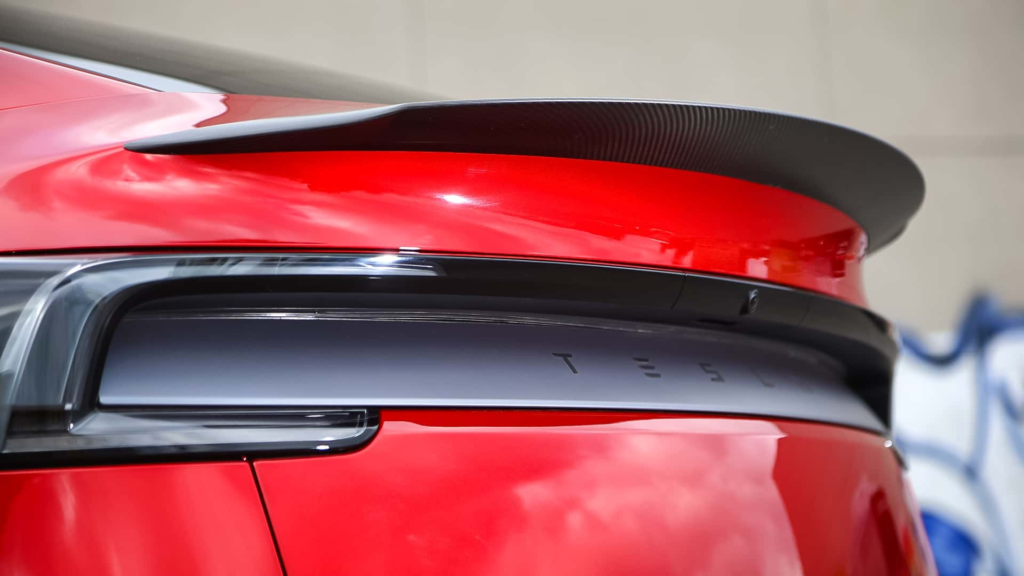
The Carbon Fiber Spoiler — Functional or Decoration?
One question worth addressing directly: does the carbon fiber spoiler actually do anything?
At normal road speeds — up to 130 km/h or so on motorways — the aerodynamic effect of a rear spoiler is modest. The main job of a spoiler on a road car at these speeds is to manage airflow to reduce lift, keeping the rear of the car planted.
At higher speeds, the effect becomes more significant, but since most driving happens well below those thresholds, the spoiler’s primary function on the road is more subtle than track-day mathematics would suggest. It does contribute to the car’s stability at speed, and it contributes a lot to how the car looks.
Whether you find the large spoiler attractive is a matter of taste. It signals clearly that this is the performance variant, which is presumably what buyers paying the premium want.
Software and Technology
The Tesla software experience is consistent across the lineup, but the larger, higher-resolution screen on the Performance model gives it more room to breathe. Navigation, streaming, and the general interface are all presented more clearly.
Tesla’s over-the-air updates mean that software features improve over time without requiring a visit to a dealer. This is something that affects every Model Y owner equally, but it’s worth noting because the hardware investment you make today continues to receive new features.
Driver assistance features — standard across Tesla’s lineup — are not significantly different on the Performance model. The camera-based system is the same hardware, running the same software.
Final Thoughts
The new Tesla Model Y Performance is a specific thing. It’s not the right car for everyone, and it doesn’t need to be.
If you want the most capable, most refined Model Y available in Europe right now — the one with the distinct R21 wheels, red calipers, and carbon fiber spoiler that announce what it is from a distance, with ventilated seats, a better screen, double glazing, and 460 horsepower available on demand — this is it.
The 3.3-second 0 to 100 km/h time isn’t something you’ll use every day. It’s there when you want it, and knowing it’s there changes how the car feels to drive even when you’re not pushing it.
At €61,990 as a starting price in Europe, it’s a premium product competing in a premium segment. It earns its place there not through marketing positioning alone, but through a set of real, tangible improvements over the standard Long Range that are visible, measurable, and noticeable from the moment you get in.
If that combination matches what you’re looking for in a car, the Performance Model Y is worth a serious look.
For more coverage of new performance EVs and electric car launches in Europe, stay up to date with Brand New Cars.

